


 English
  русский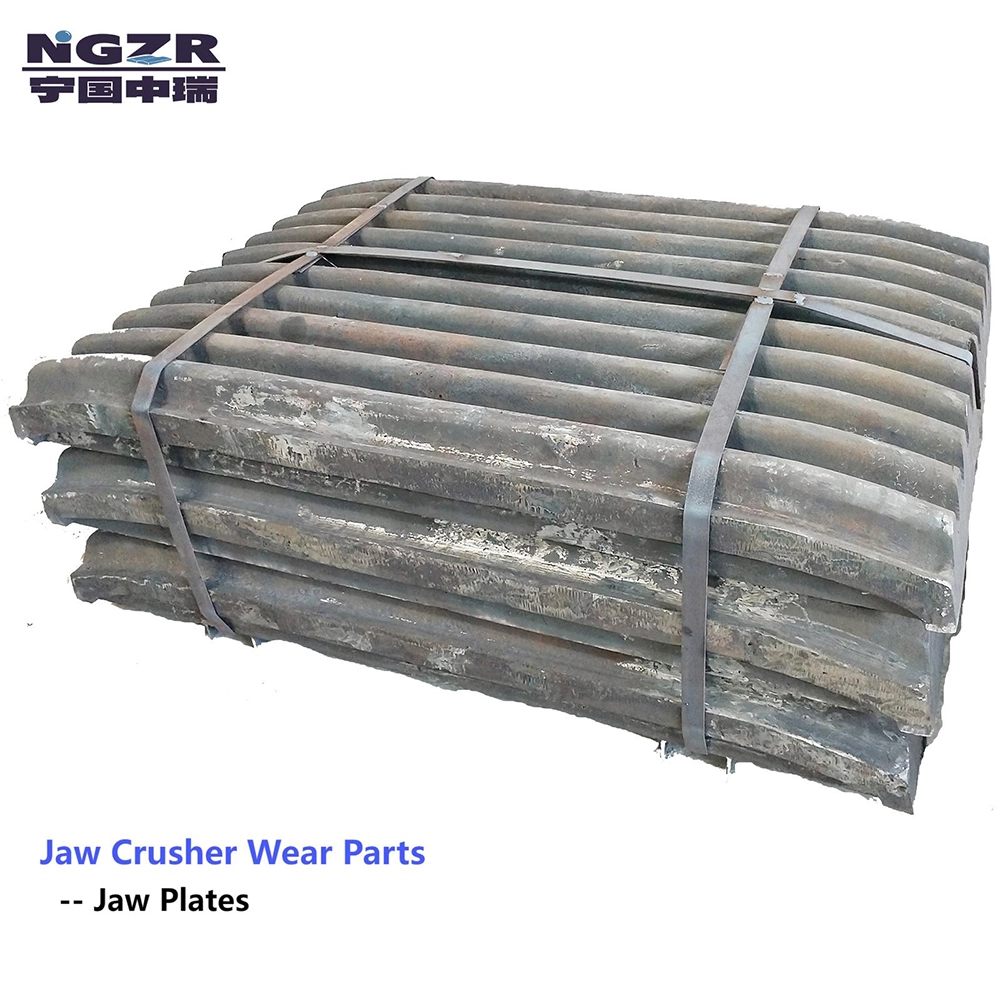








Zhongrui Wear-Resistant Materials manufactures casting jaw plates and cheek plates for jaw crushers in mining, quarrying, aggregates, cement and mineral processing. From our foundry in Ningguo City, Anhui Province, China, we cast fixed and swing jaw plates to the crusher model, feed material and wear target. Jaw plates form part of our wider crusher wear programme, which also covers chromium hammers, crusher liners, concave and mantle assemblies, and mill liners.
At a glance
- Product family: fixed jaw plates, swing jaw plates, cheek plates (side liners) and custom crusher wear castings
- Material options: high manganese steel, Mn-Cr alloy, high-chromium cast iron and bimetallic composite casting
- Processes: lost foam precision casting, resin-sand casting and shell moulding, with controlled quenching, tempering and annealing
- Annual casting output of 60,000 tons; operations certified to ISO9001, ISO14001 and ISO45001
Custom Jaw Plates Cast and Heat-Treated in Our Foundry
Our Casting Jaw Plates manufacturer programme runs on the same melting, moulding and heat treatment infrastructure that produces our grinding media and mill liners. We work from customer drawings, OEM part numbers or sample plates, and we confirm mounting dimensions, hole positions and profile before a pattern is cut. Wear-resistant castings are our core business, so jaw plates are supplied as a custom product rather than a catalogue-only item.
Because jaw plates sit at the front of the crushing circuit, the material decision is tied to the feed. Hard, abrasive rock with a controlled top size behaves differently from large, blocky feed with high impact energy. That difference sets the alloy, the section thickness and the tooth profile we recommend for the duty.
Our Casting Jaw Plates Range for Jaw Crushers
Fixed jaw plates
The stationary plate, cast to the jaw stock mounting face with the correct hole pattern and fixing geometry for wedge, bolt or clamp retention.
Swing jaw plates
The moving plate, produced in corrugated, coarse-tooth, sharp-tooth or flat profiles to balance grip, nip angle and wear distribution across the crushing chamber.
Cheek plates and side liners
Side wear protection cast from the same wear-resistant material family, matched to the jaw plate set so the chamber is protected as a complete assembly.
Related crusher wear castings
The jaw plate range sits alongside our Casting Chromium Hammer and Casting Crusher Liner families for complete crushing and screening wear coverage.
A representative product in this family is the Mn-Cr alloy cast jaw plates and cheek plates set, which shows how fixed plates, swing plates and side liners are supplied as one matched package.
Application Fit: Feed Material, Crusher Type and Duty
Jaw plate selection starts with the relationship between feed size, throughput and closed side setting. A primary crusher receiving run-of-mine rock needs a plate that tolerates impact and maintains a stable crushing profile. A secondary jaw crusher working on pre-reduced material usually sees more sliding abrasion, which shifts the material balance toward higher abrasion resistance.
- Primary crushing of hard rock, ore, quarry stone and boulders
- Secondary reduction where the feed is already screened or pre-crushed
- Construction and demolition recycling with mixed, contaminated feed
- Cement and industrial mineral plants crushing raw material and clinker feed
- Mobile and track-mounted jaw crushers where weight and wear life are both constrained
We also consider moisture, fines content and the presence of tramp metal, because these affect both wear pattern and the risk of cracking at the fixing points.
Material Selection and Wear Profile
The table below sets out the material families we cast for jaw plates and where each one fits. Final selection is confirmed against the specific working point, not chosen by default.
| Material family | Wear behaviour | Typical jaw plate fit |
|---|---|---|
| High manganese steel | Work-hardens under impact; high toughness and resistance to cracking | Primary crushing with large, blocky feed and high impact energy |
| Mn-Cr alloy | Balanced toughness and abrasion resistance with stable hardness through the section | General primary and secondary duty; fixed, swing and cheek plates |
| High-chromium cast iron | High abrasion resistance where sliding wear dominates over heavy impact | Finer, more controlled feed with lower impact loading |
| Bimetallic composite casting | Wear-resistant working face backed by a tough supporting body | Mixed impact and abrasion duty where one alloy alone is a compromise |
Critical Specifications and Configuration Options
Every jaw plate we quote is defined by dimensions and interfaces, not by a generic size name. The following are the variables that shape the casting and the pattern.
- Overall length, width and working thickness, including wear allowance
- Tooth profile: corrugated, coarse tooth, sharp tooth or flat
- Fixed, swing or cheek plate position within the crushing chamber
- Bolt hole diameter, pitch, counterbore and wedge or clamp geometry
- Mounting face flatness and contact with the jaw stock
- Part number, OEM reference and drawing revision used for approval
Where drawings are not available, we can measure from a sample plate or work from the crusher model and chamber dimensions. Patterns are retained so repeat orders keep the same geometry.
Production Capacity, Melting Control and Quality Assurance
Our foundry operates separate casting ball, casting, white mould cutting, heat treatment, raw material, finished product and physical property testing workshops. Annual output reaches 60,000 tons of cast balls and castings, which gives jaw plate orders a stable production base across manual resin-sand casting, fully automatic metal mould resin-sand shell moulding and lost foam precision casting lines.
Melting and pouring are temperature-controlled. Three VIP-1800 series melting furnaces feed a process where chemical composition is checked before and after melting on a cabinet-type PRO spectrometer, with a carbon-sulfur analyser used alongside it. Pouring temperature is measured by far-infrared instrument, and the heat treatment line performs automatic temperature-controlled quenching, reheat treatment and annealing.
- Composition adjusted before pouring if the spectrometer result deviates from specification
- Visual and dimensional inspection before despatch, with hardness testing on the physical property side
- Heat treatment records retained so a repeat order can follow the same cycle
- ISO9001 quality, ISO14001 environmental and ISO45001 occupational health and safety certification
Installation, Commissioning and Maintenance
Correct installation protects the casting as much as the alloy does. Jaw plates should seat fully against the jaw stock, with fixing hardware tightened to the crusher manufacturer's sequence and torque. Wedge and bolt systems must be checked after the first hours of running, because bedding-in movement is normal on a new plate set.
- Inspect the jaw stock and wedge seats for wear or distortion before fitting a new set
- Confirm the closed side setting after installation and re-check after the first production shift
- Record wear depth at fixed intervals so replacement is planned rather than reactive
- Isolate and lock out the crusher before any plate inspection or change-out
- Keep cheek plates in the replacement plan; worn side liners expose the frame and accelerate damage
Information We Use to Configure Your Solution
| Project information | What it determines |
|---|---|
| Crusher make, model and serial number | Chamber geometry, plate size and mounting interface |
| Drawing, part number or sample plate | Hole pattern, profile and thickness, and the pattern to be produced |
| Feed material type, size and abrasiveness | Alloy family and tooth profile |
| Throughput and closed side setting | Expected wear rate and wear allowance built into the casting |
| Quantity, delivery destination and packing needs | Order planning, crate specification and marking |
| Documentation and inspection requirements | Certificates, hardness records and despatch documentation set |
Documentation, Packing and Delivery Scope
Jaw plates are heavy, hard castings and are packed to arrive without edge damage or hole deformation. Plate sets are normally banded, separated and crated or palletised according to size, with part numbers and heat or batch identification marked so the receiving store can match the set to the crusher.
- Dimensional and visual inspection before packing
- Material and hardness records available with the despatch documents
- Plate sets matched so fixed, swing and cheek plates arrive as one identifiable order
- Installation and wear-check guidance supplied with the first order or on request
Frequently Asked Questions
What jaw plate configurations can you cast?
We cast fixed jaw plates, swing jaw plates and cheek plates or side liners in corrugated, coarse-tooth, sharp-tooth and flat profiles. Each plate is produced to the crusher's mounting geometry and hole pattern rather than to a general size category.
Which material is right for my jaw crusher?
High manganese steel suits high-impact primary duty, Mn-Cr alloy covers general primary and secondary work, high-chromium cast iron suits abrasion-dominated feed, and bimetallic composite castings handle mixed impact and abrasion. We confirm the choice after reviewing the feed, throughput and closed side setting.
Can you produce jaw plates to OEM drawings or from a sample?
Yes. We work from customer drawings, OEM part numbers, or a sample plate that we measure. Once the pattern is approved it is retained, so repeat orders keep the same dimensions and fixing details.
How is quality controlled during production?
Molten iron is checked before and after melting on a PRO spectrometer with carbon-sulfur analysis, pouring temperature is measured by far-infrared instrument, and heat treatment runs under automatic temperature control. Finished plates are inspected for dimensions, surface condition and hardness.
What information do you need to quote a jaw plate set?
Send the crusher make and model, an existing drawing or part number, the feed material and size, throughput, closed side setting, order quantity and delivery destination. With those details we can confirm the alloy, profile, thickness and packing scope in the quotation.
Do you supply cheek plates and side liners with the jaw plates?
Yes. Cheek plates and side liners are part of the Casting Jaw Plates range and are normally supplied as a matched set with the fixed and swing plates so the crushing chamber is protected as a complete assembly.



